Choosing between AWS, Azure, and Google Cloud Platform (GCP) can be overwhelming—especially when each cloud provider offers similar services with different names, architectures, and strengths.
If you’re a DevOps engineer, cloud architect, SRE, platform engineer, or even preparing for interviews, understanding how major cloud services map across providers is a must-have skill.
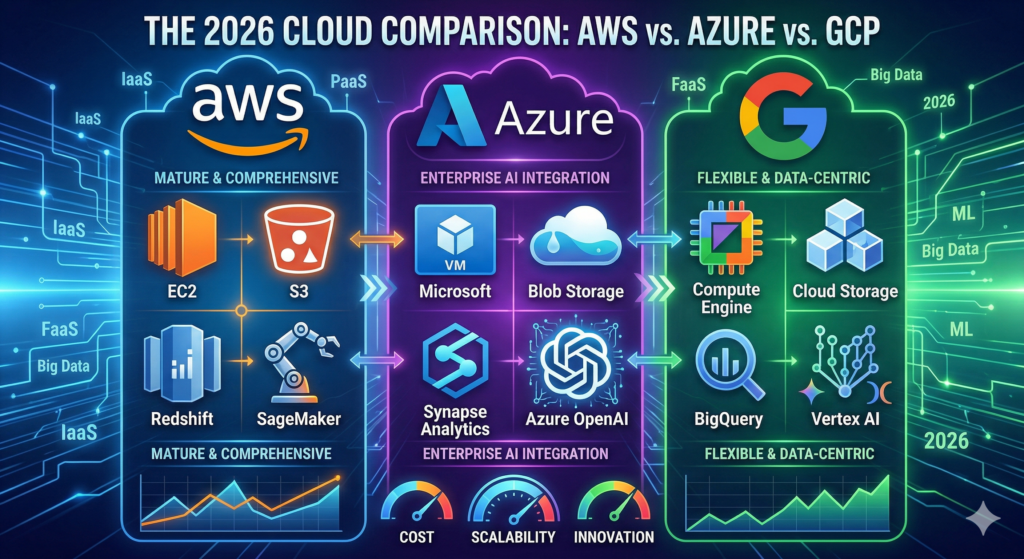
In this guide, I’ve created a side-by-side comparison of the top 30 cloud services across AWS, Azure, and GCP, grouped by category so you can quickly identify equivalents and understand where each cloud shines in 2026.
Why This Comparison Matters
Cloud teams rarely stay locked into one provider forever.
You may need to:
- migrate workloads from one cloud to another
- design multi-cloud architectures
- understand service equivalents during interviews
- choose the right provider for a new project
- compare costs, operational complexity, and ecosystem fit
The challenge is that:
- AWS has the deepest catalog
- Azure is strongest in enterprise and Microsoft ecosystems
- GCP is often preferred for data, analytics, Kubernetes, and AI
This article gives you a practical mapping of the top 30 most important services across all three.
1) Compute & Containers
Cloud compute is where most workloads begin: VMs, containers, Kubernetes, serverless, and batch jobs.
| Category | AWS | Azure | GCP |
|---|---|---|---|
| Virtual Machines | EC2 | Azure VMs | Compute Engine |
| Kubernetes (Managed) | EKS | AKS | GKE |
| Serverless Functions | Lambda | Azure Functions | Cloud Functions |
| Container Platform | ECS | Container Apps | Cloud Run |
| Platform as a Service | Elastic Beanstalk | App Service | App Engine |
| Batch Processing | AWS Batch | Azure Batch | Batch |
Key Differences
- EC2 vs Azure VMs vs Compute Engine: All provide flexible VMs, but AWS offers the widest instance family variety, Azure integrates deeply with Windows/enterprise tooling, and GCP is often praised for simpler VM UX and pricing transparency.
- EKS vs AKS vs GKE:
- GKE is often considered the most mature managed Kubernetes experience.
- EKS is powerful but can be more operationally involved.
- AKS is a strong middle ground, especially in Microsoft-heavy orgs.
- Lambda vs Azure Functions vs Cloud Functions: AWS Lambda remains the most battle-tested, Azure Functions is excellent for .NET ecosystems, and GCP Cloud Functions is lightweight and simple for event-driven apps.
- ECS vs Container Apps vs Cloud Run:
- ECS is AWS-native and simpler than Kubernetes.
- Azure Container Apps offers a serverless container experience.
- Cloud Run is one of the most developer-friendly serverless container platforms available.
- Elastic Beanstalk vs App Service vs App Engine: Azure App Service is often preferred for traditional web app hosting, while App Engine and Beanstalk are more opinionated PaaS options.
2) Storage & Content Delivery
Storage is foundational for applications, backups, data lakes, logs, and static content delivery.
| Category | AWS | Azure | GCP |
|---|---|---|---|
| Object Storage | S3 | Blob Storage | Cloud Storage |
| Block Storage (Disk) | EBS | Azure Disk | Persistent Disk |
| File Storage (NFS) | EFS | Azure Files | Filestore |
| Archive / Cold Storage | S3 Glacier | Archive Storage | Archive Class |
| CDN | CloudFront | Azure Front Door | Cloud CDN |
| Hybrid Storage | Storage Gateway | Azure Stack | Anthos / Storage |
Key Differences
- S3 vs Blob Storage vs Cloud Storage:
- S3 is the industry standard and often the benchmark.
- Azure Blob is strong for enterprise and Microsoft integrations.
- Cloud Storage is simple, performant, and very clean for data pipelines.
- EBS vs Azure Disk vs Persistent Disk: All are managed block storage for VMs. GCP’s Persistent Disk is often praised for ease of use and consistency.
- EFS vs Azure Files vs Filestore:
- EFS is common in Linux/NFS-heavy AWS workloads.
- Azure Files supports SMB and works well in Windows environments.
- Filestore is a solid managed NFS option in GCP.
- CloudFront vs Front Door vs Cloud CDN:
- CloudFront is highly mature and tightly integrated with AWS.
- Azure Front Door combines CDN + global load balancing + WAF style use cases.
- Cloud CDN pairs well with Google’s network and load balancers.
3) Databases
Managed databases are one of the biggest decision points in cloud architecture.
| Category | AWS | Azure | GCP |
|---|---|---|---|
| Relational (Managed) | RDS | Azure SQL Database | Cloud SQL |
| NoSQL (Document) | DynamoDB | Cosmos DB | Firestore |
| NoSQL (Wide-column) | Keyspaces | Cosmos DB (Table) | Bigtable |
| In-Memory / Redis | ElastiCache | Cache for Redis | Memorystore |
| Global / Spanner DB | Aurora Global | Cosmos DB | Cloud Spanner |
| Graph Database | Neptune | Cosmos DB (Gremlin) | — (Partner) |
Key Differences
- RDS vs Azure SQL Database vs Cloud SQL:
- RDS supports multiple engines and is extremely common.
- Azure SQL Database is ideal if you’re heavily invested in SQL Server.
- Cloud SQL is great for straightforward managed MySQL/PostgreSQL/SQL Server.
- DynamoDB vs Cosmos DB vs Firestore:
- DynamoDB is ultra-scalable and operationally minimal.
- Cosmos DB is globally distributed and supports multiple APIs.
- Firestore is fantastic for mobile/web app developer velocity.
- Aurora Global vs Cosmos DB vs Cloud Spanner:
- Cloud Spanner is unique and highly respected for horizontally scalable relational workloads.
- Cosmos DB is more globally distributed NoSQL/multi-model.
- Aurora Global is great for AWS-native globally replicated relational apps.
- Graph Databases: AWS Neptune is the clearest first-party managed graph option among the three hyperscalers.
4) Analytics & Big Data
This is where GCP often stands out, but all three have strong offerings.
| Category | AWS | Azure | GCP |
|---|---|---|---|
| Data Warehouse | Redshift | Synapse Analytics | BigQuery |
| Hadoop / Spark | EMR | HDInsight | Dataproc |
| Data Streaming | Kinesis | Event Hubs | Pub/Sub |
| ETL / Data Pipeline | Glue | Data Factory | Dataflow |
| Business Intelligence | QuickSight | Power BI | Looker |
Key Differences
- Redshift vs Synapse vs BigQuery:
- BigQuery is widely considered the easiest and most powerful for serverless analytics.
- Redshift is strong in AWS-native data platforms.
- Synapse is valuable in Microsoft enterprise ecosystems.
- EMR vs HDInsight vs Dataproc:
- EMR is mature and widely used.
- Dataproc is often simpler for Spark/Hadoop clusters.
- HDInsight is less commonly favored in modern cloud-native builds compared to Synapse/Fabric-oriented paths.
- Kinesis vs Event Hubs vs Pub/Sub:
- Pub/Sub is extremely elegant for messaging/eventing.
- Kinesis is AWS-native and powerful for streaming ingestion.
- Event Hubs fits well with Azure event pipelines.
- Glue vs Data Factory vs Dataflow:
- Glue is ETL-centric and AWS ecosystem friendly.
- Data Factory is orchestration-heavy and enterprise-friendly.
- Dataflow shines for Apache Beam and large-scale streaming/batch pipelines.
- QuickSight vs Power BI vs Looker:
- Power BI dominates business adoption.
- Looker is strong in modern analytics modeling.
- QuickSight is solid but often less preferred outside AWS-native stacks.
5) AI & Machine Learning
In 2026, this category matters more than ever.
| Category | AWS | Azure | GCP |
|---|---|---|---|
| ML Platform | SageMaker | Azure Machine Learning | Vertex AI |
| Generative AI / LLMs | Bedrock | Azure OpenAI | Vertex AI (Gemini) |
| Computer Vision | Rekognition | Computer Vision | Vision AI |
| Speech-to-Text | Transcribe | Speech to Text | Speech-to-Text |
| Chatbots | Lex | Bot Service | Dialogflow |
Key Differences
- SageMaker vs Azure ML vs Vertex AI:
- SageMaker is feature-rich and enterprise-grade.
- Azure ML is strong for enterprise governance and Microsoft alignment.
- Vertex AI is often praised for cleaner UX and modern AI workflow integration.
- Bedrock vs Azure OpenAI vs Vertex AI (Gemini):
- Azure OpenAI wins in enterprise adoption due to governance and Microsoft trust.
- Bedrock offers access to multiple foundation models in AWS.
- Vertex AI is compelling for teams building deeply integrated GenAI + data workflows.
- Dialogflow remains a standout for conversational interfaces, especially compared to older chatbot-first abstractions.
6) Networking & Security
These services define your cloud foundation.
| Category | AWS | Azure | GCP |
|---|---|---|---|
| Virtual Network | VPC | VNet | VPC |
| DNS | Route 53 | Azure DNS | Cloud DNS |
| Identity Management | IAM | Microsoft Entra ID (Azure AD) | IAM |
Key Differences
- VPC vs VNet vs VPC: All provide virtual private networking, but implementation details differ around routing, peering, private endpoints, and firewall models.
- Route 53 vs Azure DNS vs Cloud DNS: Route 53 is especially strong due to its tight integration with health checks, routing policies, and AWS services.
- IAM vs Entra ID vs IAM:
- AWS IAM is deeply granular and powerful.
- Microsoft Entra ID dominates enterprise identity and hybrid AD scenarios.
- GCP IAM is clean and role-centric, with strong project/folder/org hierarchy models.
Which Cloud Is Best in 2026?
There is no universal “best” cloud. The right answer depends on your workloads, team skillset, ecosystem, and business priorities.
AWS: Best for Breadth and Ecosystem Depth
Choose AWS if you need:
- the widest service catalog
- mature global infrastructure
- strong community and third-party tooling
- niche services (IoT, edge, quantum, satellite, etc.)
- deep support for almost any architecture pattern
Best for: startups, platform teams, complex multi-service architectures, niche workloads
Azure: Best for Enterprise and Microsoft-Centric Organizations
Choose Azure if you need:
- deep integration with Microsoft 365 / Windows Server / Active Directory
- enterprise procurement and governance
- strong hybrid cloud capabilities
- easier adoption for .NET / SQL Server / Microsoft-heavy teams
- enterprise AI adoption via Azure OpenAI
Best for: enterprises, Microsoft shops, hybrid cloud, regulated organizations
GCP: Best for Data, Kubernetes, and AI-First Teams
Choose GCP if you need:
- world-class analytics with BigQuery
- strong Kubernetes experience with GKE
- simple and elegant cloud UX
- high-performance networking
- modern AI/ML workflows with Vertex AI and Gemini
Best for: data platforms, ML teams, cloud-native startups, Kubernetes-heavy workloads
Quick Decision Matrix
Choose AWS if:
- you want the most services
- you need maximum ecosystem maturity
- you expect unusual or advanced requirements
Choose Azure if:
- your company already uses Microsoft heavily
- identity, governance, and enterprise integration matter most
- you want strong enterprise GenAI options
Choose GCP if:
- your workloads are data-heavy
- Kubernetes is central to your platform
- your team values developer experience and AI workflows
Final Thoughts
If you’re learning cloud in 2026, don’t just memorize service names.
Instead, learn the patterns:
- compute
- storage
- databases
- networking
- security
- analytics
- AI/ML
Once you understand the pattern, mapping services across AWS, Azure, and GCP becomes much easier.
For DevOps engineers, platform engineers, and SREs, this skill is incredibly valuable for:
- architecture design
- cloud migration
- multi-cloud planning
- interview preparation
- certification study
My Takeaways for 2026
- AWS still wins on depth: if you have a strange or highly specialized requirement, AWS usually has a native service for it.
- Azure is the enterprise cloud: unbeatable when Microsoft identity, Office, Windows, and enterprise procurement are involved.
- GCP is the data + AI cloud: BigQuery, GKE, and Vertex AI continue to make it one of the most developer-loved platforms.
Conclusion
Whether you’re building your first cloud app or designing a multi-cloud platform, knowing the service equivalents across AWS, Azure, and GCP helps you make faster and better decisions.
If you found this guide useful, bookmark it as your cloud service equivalency cheat sheet for 2026.
Leave a Reply