In the traditional financial world, if more money is needed, a central bank turns on the printing press.
In decentralized finance (DeFi), there is no central printer.
Instead, new digital assets enter circulation through protocol-defined issuance mechanisms — primarily Mining and Minting.
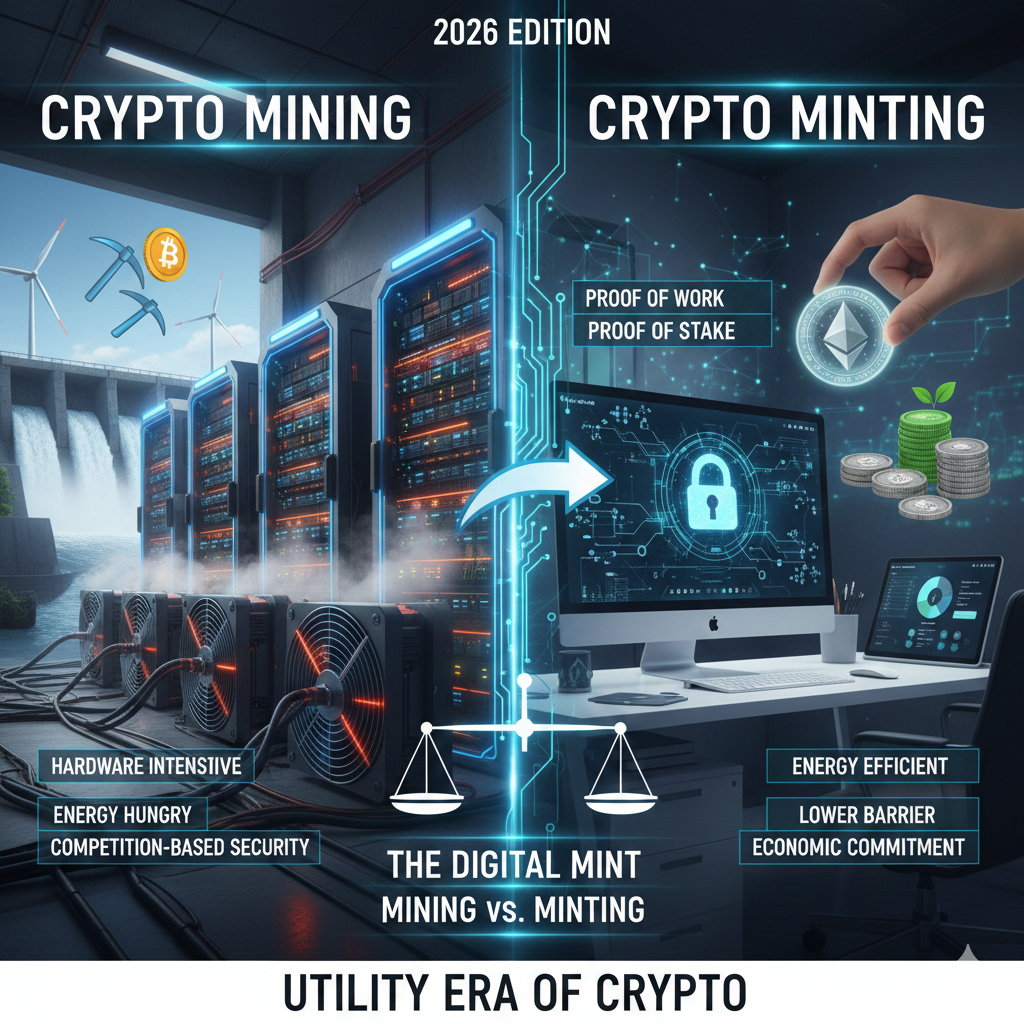
While newcomers often use these terms interchangeably, they represent two fundamentally different philosophies about:
- How blockchains stay secure
- How trust is established
- How rewards are distributed
- How sustainability is achieved
As we move deeper into the Utility Era of Crypto (2026), understanding this distinction isn’t optional — it’s foundational.
1. Crypto Mining: The Digital Gold Rush
Mining is the original mechanism introduced by Bitcoin in 2009.
It operates using a consensus mechanism called:
Proof of Work (PoW)
Here’s how it works:
- Miners use specialized hardware (ASICs or GPUs).
- They compete to solve complex cryptographic puzzles.
- The first miner to solve the puzzle:
- Validates the block
- Adds it to the blockchain
- Receives newly created coins (block reward)
It’s not collaboration.
It’s competition.
Core Characteristics of Mining
1. Hardware Intensive
Mining requires:
- ASIC miners (Application-Specific Integrated Circuits)
- Industrial-scale GPU farms (for some chains)
This is capital-heavy infrastructure.
2. Energy Hungry
Proof of Work consumes massive electricity because:
- Millions of machines compete simultaneously
- Only one wins
- All others waste computational effort
In 2026, many industrial miners operate under:
- Renewable energy models
- Hydro or geothermal setups
- “Curtailment agreements” (selling power back to the grid during peak demand)
Mining has become more strategic than speculative.
3. Competition-Based Security
Security in PoW comes from:
- Hash power dominance
- Economic cost of attacking the network
To attack Bitcoin, you must control 51% of total hash power — a near-impossible financial feat.
This is why Bitcoin is still considered the most battle-tested decentralized network.
Major PoW Networks
- Bitcoin
- Litecoin
- Monero
2.Crypto Minting: The Modern Standard
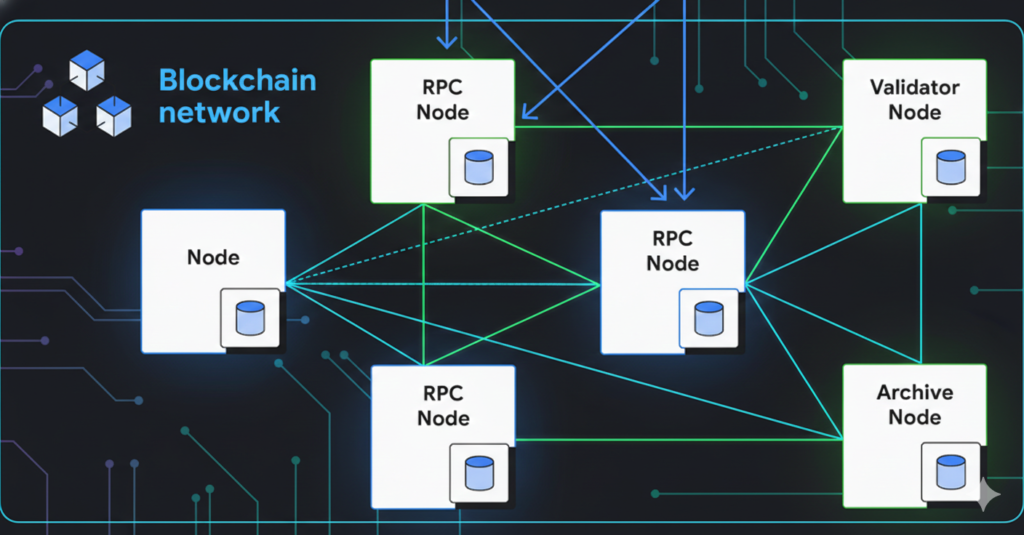
Minting is associated with:
Proof of Stake (PoS)
Instead of solving puzzles with electricity, the network selects validators based on:
The amount of tokens they have “staked” (locked as collateral).
If you have skin in the game, you are economically incentivized to behave honestly.
When selected:
- You validate transactions
- A new block is created
- New coins are minted
- You receive rewards
It’s not a race.
It’s weighted participation.
Core Characteristics of Minting
1. Energy Efficient
No puzzle-solving race.
Most PoS networks use:
- ~99% less energy than PoW systems
This became a defining moment after Ethereum transitioned from PoW to PoS in 2022.
2. Lower Barrier to Entry
To become a validator:
- You need tokens
- A standard server
- Reliable internet
Or simply:
- Join a staking pool
- Delegate your tokens
- Earn passive rewards
No warehouses required.
3. Expanded Meaning of “Minting”
Minting also refers to creating:
- NFTs
- Stablecoins
- Tokenized assets
- Governance tokens
Through smart contracts.
For example:
- Minting an NFT = creating a unique on-chain asset
- Minting a stablecoin = issuing collateral-backed digital dollars
Major PoS Networks
- Ethereum (Post-Merge)
- Cardano
- Solana
- Polkadot
Mining vs. Minting — Side-by-Side
| Feature | Crypto Mining (PoW) | Crypto Minting (PoS) |
|---|---|---|
| Primary Driver | Computational Power | Staked Assets |
| Security Model | Energy + Hashrate | Economic Stake |
| Equipment | ASICs / GPUs | Basic Server / Wallet |
| Energy Use | Very High | Very Low |
| Role Name | Miner | Validator |
| Entry Barrier | High Capital | Token-Based |
Philosophical Difference
Mining says:
“Security comes from measurable work.”
Minting says:
“Security comes from economic commitment.”
Mining is industrial.
Minting is financial.
Mining burns electricity.
Minting locks capital.
The 2026 Outlook: Which One Wins?
In 2026, the trend leans heavily toward Minting (PoS).
Why?
ESG Compliance
Institutions prioritize Environmental, Social, and Governance (ESG) standards.
PoS networks:
- Consume dramatically less power
- Are easier to integrate into institutional infrastructure
- Reduce carbon footprint concerns
Capital Efficiency
Instead of spending money on hardware, investors:
- Lock tokens
- Earn yield
- Maintain liquidity strategies
However…
Mining Isn’t Dead
Bitcoin remains:
- The most decentralized asset
- The most censorship-resistant chain
- The “Digital Gold” narrative leader
Its 2026 milestone of 20 million BTC mined reinforces:
- Scarcity
- Predictable issuance
- Monetary discipline
Bitcoin mining has matured into:
- Nation-state mining operations
- Grid-balancing infrastructure
- Strategic energy monetization
PoW isn’t disappearing.
It’s consolidating.
Why This Matters to You
Your strategy depends on your capital and goals.
If You Want to Be a Miner
You’ll need:
- Significant upfront hardware investment
- Access to cheap electricity
- Cooling infrastructure
- Regulatory awareness
Mining is now a business — not a hobby.
If You Want to Be a Validator (Minter)
You can:
- Stake your tokens
- Join staking pools
- Earn passive yield
- Avoid hardware investment
This is why PoS participation has grown dramatically among retail users.
The Bigger Picture: The Utility Era
We are moving from:
Speculation Era → Infrastructure Era → Utility Era
In this new phase:
- Networks must be sustainable
- Yield must be predictable
- Security must be economically aligned
Mining built crypto.
Minting is scaling it.
Final Thoughts
Mining and Minting are not just technical mechanisms.
They represent two schools of thought:
- Proof of Work: Trust the math.
- Proof of Stake: Trust the stake.
Both have a role.
Both secure billions in value.
But as the industry matures in 2026, understanding these differences helps you:
- Choose better investments
- Participate intelligently
- Align with future regulatory trends
- Build smarter Web3 strategies
Because in the decentralized world…
There is no printing press.
Only protocol.
Leave a Reply