How Farcaster and Lens Protocol are Decoupling Data from Platforms
The internet scaled connection. Big Tech scaled extraction. Web3 is scaling ownership.
For fifteen years, social media has functioned as a series of proprietary silos. In the Web2 model, the platform is the judge, jury, and data executioner:
- Identity is leased, not owned.
- Content is a liability on a centralized balance sheet.
- Monetization is an asymmetric ad-engine.
- Governance is an opaque boardroom decision.
SocialFi (Social Finance) is the architectural pivot. It’s the transition from social as a service to social as infrastructure. Leading this shift are two distinct design philosophies: Farcaster and Lens Protocol.
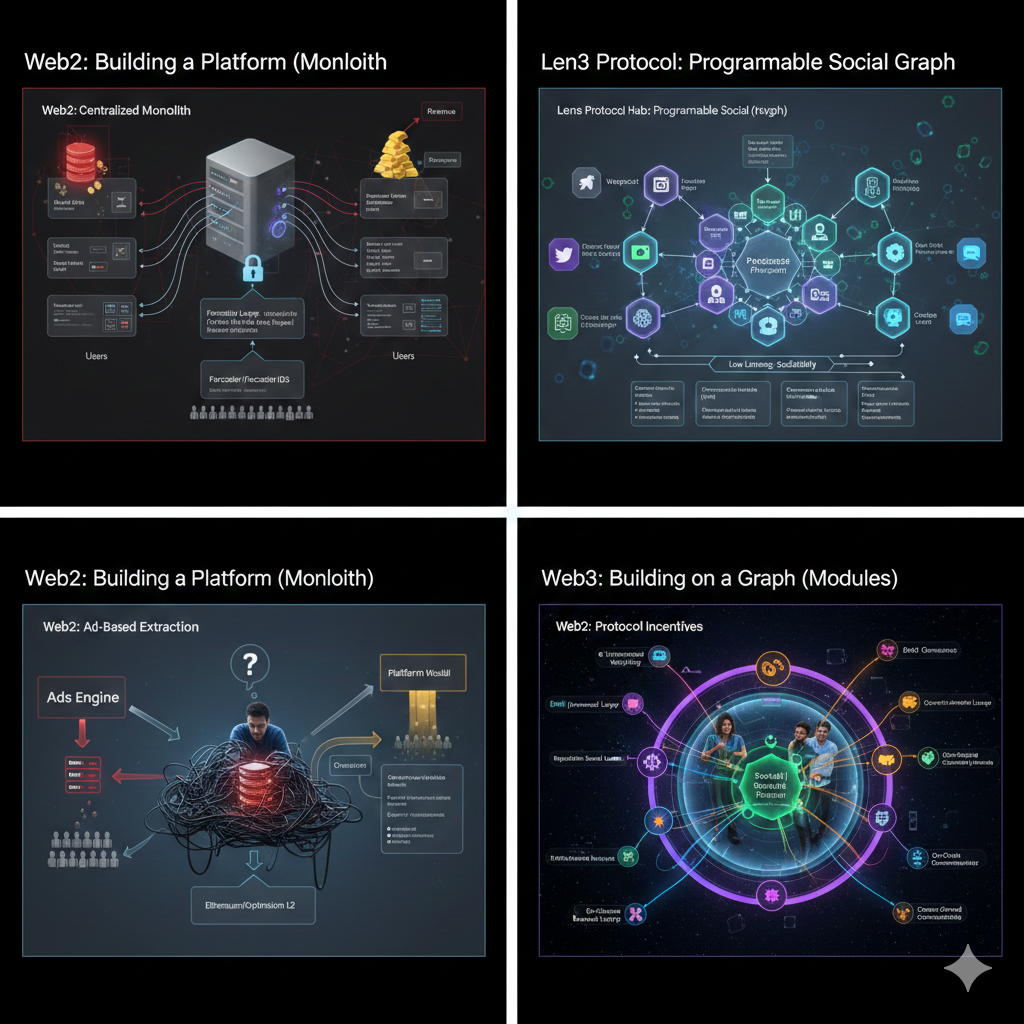
The Core Bottleneck: Monolithic Social Architecture
In traditional systems, the “Control Plane” and the “Data Plane” are fused.
The Web2 Stack: >
Users → Centralized Servers → Proprietary Algorithms → Ad Revenue
From an infrastructure standpoint, this creates a single point of failure and control. The platform owns the identity database, the social graph, and the distribution rails. This results in vendor lock-in and “API fragility”—where developers building on the platform are at the mercy of the owner.
What is SocialFi? (The Systems View)
SocialFi isn’t just “Twitter on a blockchain.” It is a composable protocol architecture built on four decentralized primitives:
- Sovereign Identity: On-chain, portable IDs.
- Open Graphs: Relationship data that isn’t locked in a silo.
- Content Provenance: Cryptographically signed data.
- Programmable Incentives: Value flow defined by smart contracts, not ad sales.
1. Farcaster: The Hybrid “Off-Chain Data, On-Chain Identity” Model
Farcaster prioritizes performance and pragmatism. It operates on the belief that while identity must be decentralized, every “like” doesn’t need to live on a global ledger.
The Architecture
- Identity Layer: Anchored on Ethereum/Optimism.
- Data Layer: Managed by “Hubs”—nodes that sync message data off-chain but verify it cryptographically.
- Client Layer: Fully decoupled. Anyone can build a UI (like Warpcast) on top of the shared data.
The Engineering Win: This hybrid approach solves the latency problem. It feels like Web2 speed but retains Web3 guarantees. It’s “crypto-secured,” but architected for high-frequency interaction.
2. Lens Protocol: The “Social Graph as an Asset” Model
Lens takes a “Chain-Native” approach. It treats the social graph as a liquid, programmable asset.
The Architecture
- Profiles as NFTs: Your identity is a tradable, composable token.
- Interactions as Modules: “Follows” and “Mirrors” (retweets) are smart contract actions.
- Logic is Programmable: Creators can set “Follow Modules” (e.g., “You must pay 5 MATIC to follow me” or “Hold this NFT to comment”).
The Engineering Win: Lens turns social interactions into LEGO bricks. It’s not just a feed; it’s a programmable reputation economy where DeFi and Social are natively merged.
SocialFi as Infrastructure: A DevOps Paradigm Shift
If we look at this through a DevOps lens, the shift looks like this:
| Feature | Web2 (Legacy) | SocialFi (Modern Stack) |
| System Design | Monolithic Application | Distributed Protocol |
| Database | Proprietary/Closed | Permissionless/Shared |
| API Access | Rate-limited/Gated | Fully Open/Composable |
| Governance | Corporate Policy | On-chain DAO/Code |
Instead of building a “Social Network,” developers are now deploying Social Microservices on top of a shared, global state.
The Engineering Challenges (The SRE Perspective)
Decentralizing the social layer isn’t free. We are currently tackling:
- State Bloat: Storing social graphs on-chain is expensive and scales poorly without L2/L3 solutions.
- Content Moderation: In a permissionless system, “censorship resistance” is a feature, but “harmful content” is a bug. The solution lies in decentralized curation algorithms, not global bans.
- UX Friction: Gas fees and seed phrases are “conversion killers.” Account Abstraction (ERC-4337) is the necessary patch here.
The Bottom Line
Web2 was about scaling traffic. Web3 Social is about scaling trust.
For the infrastructure engineer, SocialFi represents the next frontier of distributed systems. We are moving away from building “walled gardens” and toward building “public utilities.” Farcaster and Lens aren’t just apps—they are the first stable releases of a new, sovereign social layer for the internet.
Leave a Reply