In the world of DevOps, monitoring isn’t just a dashboard on a wall; it’s your early warning system. But when you’re standing at the crossroads of Amazon CloudWatch, Google Cloud Monitoring, Azure Monitor, and Grafana, it’s easy to get lost in the “which is better?” debate.
Here’s the truth: They aren’t really rivals. They’re more like a powerhouse engine and a high-tech cockpit.
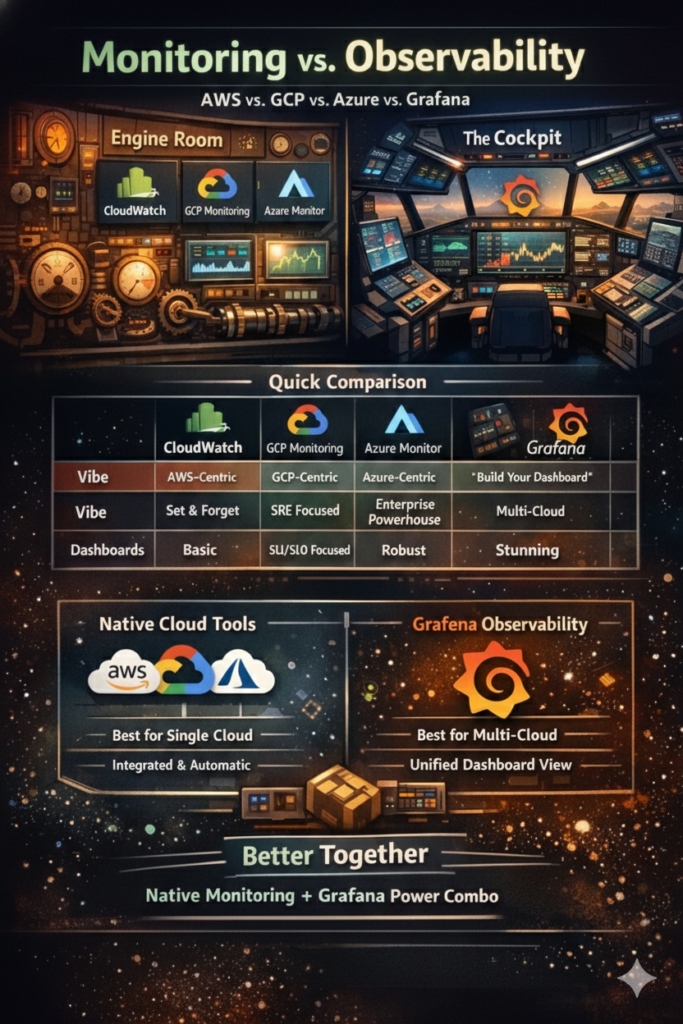
1. The Core Identities
- Amazon CloudWatch (The Engine): This is AWS’s “home turf” monitoring. It’s built into the fabric of your EC2s, Lambdas, and RDS instances. If it happens in AWS, CloudWatch knows about it before you even refresh your browser.
- Google Cloud Monitoring (The Specialist): GCP’s native tool (formerly Stackdriver) is famous for its SLI/SLO (Service Level Objective) focus. It’s the expert for anything GKE, BigQuery, or specific GCP services.
- Azure Monitor (The Enterprise Workhorse): Azure Monitor is a beast—it combines metrics, logs (Log Analytics), and application insights. If you’re heavy on Windows, Active Directory, or AKS, this is your go-to.
- Grafana (The Cockpit): Grafana doesn’t actually “own” any data. It’s a visualization genius. It reaches out, grabs data from CloudWatch, Prometheus, SQL, GCP Monitoring, Azure Monitor, or even your neighbor’s smart fridge (if it has an API), and turns it into a masterpiece of a dashboard.
2. The “Quick Glance” Multi-Cloud Comparison
| Feature | AWS CloudWatch | GCP Monitoring | Azure Monitor | Grafana (The Unifier) |
| Vibe | “Set it and forget it” | “SRE focused” | “Enterprise powerhouse” | “Build your dream UI” |
| Ecosystem | Strictly AWS-centric | Strictly GCP-centric | Strictly Azure-centric | Multi-cloud & Hybrid |
| Setup | Zero-touch (Automatic) | Mostly Automatic | Mostly Automatic | Requires some “assembly” |
| Dashboards | Functional (The “utility” look) | Moderate (Better than AWS) | Robust | Stunning (The “War Room” look) |
| Pricing | Pay-as-you-grow (can get spicy) | Pay-as-you-grow | Pay-as-you-grow | Open Source is free; Cloud is usage-based |
3. Where They Shine (and Where They Don’t)
The Native Cloud Tools (CloudWatch, GCP Monitoring, Azure Monitor): The Cloud Purist’s Choice
If you are 100% committed to a single cloud, its native monitoring is your best friend.
- The Win: You get logs, metrics, and alarms without installing a single agent. Seamless integration, managed service, and often the first to support new cloud features.
- The Catch: They can feel like “walled gardens.” Visualizing data from outside their specific cloud is like trying to fit a square peg in a round hole. Correlating an issue across AWS and Azure is a manual, frustrating exercise.
Grafana: The Observability Architect’s Choice
Grafana is for the teams that want a “Single Pane of Glass,” no matter where their services live.
- The Win: You can overlay your AWS metrics right next to your GCP database latency and your Azure API call rates. You gain a holistic view crucial for complex, distributed systems.
- The Catch: You have to manage it (unless you use Amazon Managed Grafana or Grafana Cloud). You also need a place to store the data, like Prometheus for metrics or Loki for logs, for sources not directly streaming to Grafana.
4. The 2026 Production Reality: “The Multi-Cloud Power Couple”
Most mature engineering teams don’t pick a side. They realize that Native Cloud Tools + Grafana = SRE Bliss.
- Native Cloud Tools (CloudWatch, GCP Monitoring, Azure Monitor) act as the ingestion layer (collecting the raw data from their respective clouds).
- Grafana acts as the presentation layer (querying these native tools and other data sources to show you what actually matters).
Infradiaries Tip: Don’t let your Cloud bills surprise you. High-resolution custom metrics and heavy log ingestion can get expensive. Look into strategies like CloudWatch Metric Streams, OpenTelemetry (OTel), and efficient log routing to push data to Grafana/Prometheus for a more cost-effective, real-time experience that transcends individual cloud boundaries.
The Final Verdict
- Choose the Native Cloud Tools (CloudWatch, GCP Monitoring, Azure Monitor) if you’re a startup or a single-cloud shop that needs to move fast with zero maintenance within that specific cloud.
- Choose Grafana if you’re running Kubernetes, multi-cloud, or simply want a unified dashboard that doesn’t force you to juggle multiple consoles to understand your entire system’s health.
Monitoring is about answering two questions: “Is it broken?” and “Why?” The native cloud tools tell you something might be broken within their domain; Grafana helps you understand why across your entire, interconnected ecosystem.
Leave a Reply